Early written maps
The course manual identifies Philippus Meyens’s 1670 work as an early description of dividing the iris into regions associated with parts of the body.
Holistic iridology
Explore my holistic iridology learning journey, inspired by Dr. Pesek’s approach to the physical, mental, emotional, and spiritual aspects of wellness.
A place to start
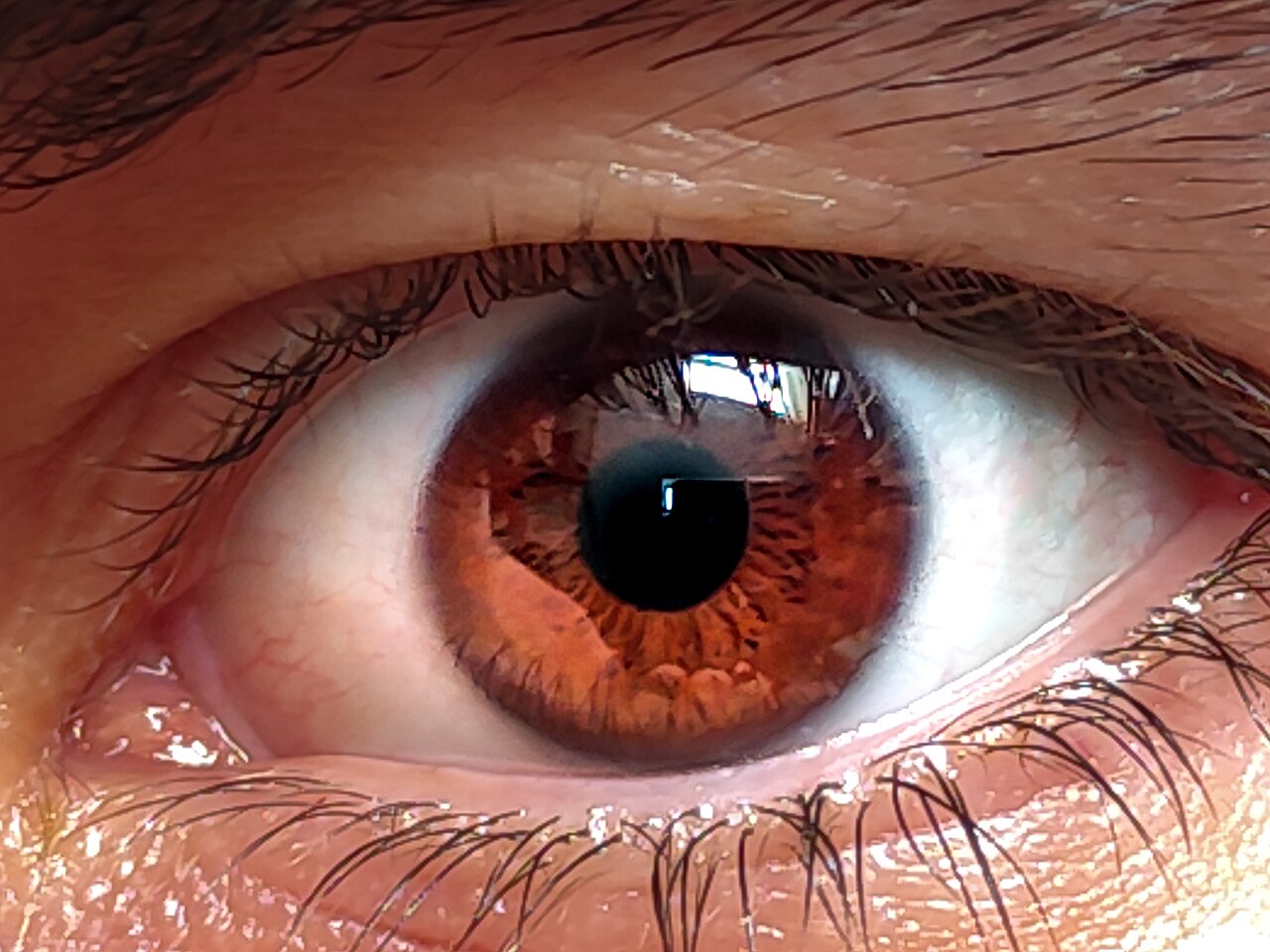
Iridology is a traditional practice in which practitioners observe the colors, patterns, and structures of the iris and interpret them through a particular system of teachings. The word combines “iris,” the colored part of the eye, with “-ology,” the study of a subject.
Holistic Iridology®, developed by David J. Pesek, expands that traditional framework to consider physical, mental, emotional, and spiritual aspects of life. These are teachings of the system, rather than medical conclusions that can be established from an eye photograph. [1]
My interest is in learning, careful observation, and the bigger picture of everyday wellness. I’m studying holistic iridology and am not a certified practitioner.
Continue exploring
Explore complimentary student practice readings, the photo submission process, and future educational reading options.
Explore Holistic Iris ReadingsEducational and non-diagnostic. I am a holistic iridology student, not a certified practitioner.
How the tradition developed
Looking at the eyes has a long history in healthcare. The specific practice of assigning meanings to iris markings developed its own traditions over time. The overview below follows the historical account in my Level I course manual; it describes the development of a practice, not proof that its interpretations are accurate.
The course manual identifies Philippus Meyens’s 1670 work as an early description of dividing the iris into regions associated with parts of the body.
Hungarian physician Ignaz von Péczely became an influential figure in the development of modern iridology through his writing and iris mapping.
Bernard Jensen helped popularize iridology in the United States. Josef Deck and Josef Angerer were influential figures in German traditions. Different schools developed their own terminology and interpretive approaches.
David J. Pesek brought together teachings from different traditions in his system, with an emphasis on physical, mental, emotional, and spiritual perspectives. This is the approach I’m currently studying. [1]
Learn the language
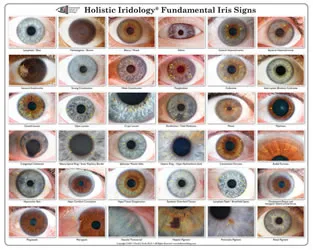
The iris is the colored tissue around the pupil. Its muscles change pupil size to regulate how much light enters the eye. The pupil is an opening; it is not a black spot of iris tissue. These are established anatomical facts. [2]
The overall color and visible pigment patterns are part of an iris’s appearance. An iris photo alone cannot establish a nutritional deficiency or tell us how a distant organ is functioning.
The surface has a textured pattern that often looks like lines radiating away from the pupil. Iris patterns vary between people; genetic research has studied features such as crypts and furrows. [3]
A raised, often irregular boundary separates the inner pupillary region from the outer ciliary region. Learning to describe its visible shape is different from using it to make claims about digestion or emotional traits.
These are openings or depressions in the iris’s surface tissue. They are recognizable anatomical features; their presence does not, by itself, diagnose a health problem. [3]
These are circular or partly circular folds visible toward the outer iris. Some iridology traditions give them additional interpretive names. A traditional label should not be confused with a measured stress level.
The cornea is the clear covering in front of the iris. The sclera is the white outer tissue. Some iridology systems also observe these areas, but that is not a substitute for an eye examination.
A useful first step: describe what is visible before attaching an interpretation to it. Anatomy and terminology draw on eye-health education and iris-pattern research. [2, 3]
A traditional framework
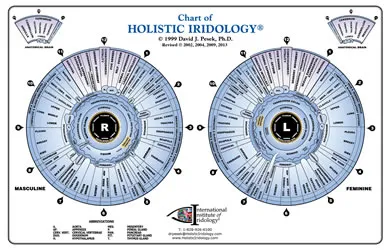
An iris chart is a map used within an iridology system. It associates locations around the iris with body regions, organs, or other concepts. Practitioners may describe locations like positions on a clock, along with rings or zones.
Charts are teaching tools within those traditions. They are not established anatomical maps showing a direct organ-by-organ connection to the iris. Different schools can use different charts and interpretations.
“There is a darker pigment area” describes something visible. “That means a particular organ is weak” adds a health interpretation that has not been established by that observation.
That distinction matters whenever I share what I’m learning.
Looking at the bigger picture
Pesek’s teachings consider four connected aspects of life. I use this framework to explain the perspective I’m studying—not to suggest an iris image can prove someone’s thoughts, emotions, beliefs, or physical condition. [1]
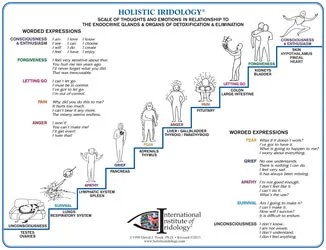
The body and the everyday foundations of food, hydration, movement, sleep, and rest.
Thought patterns, attention, learning, and the demands we navigate each day.
Feelings, personal experiences, and having space to reflect on what life asks of us.
Meaning, values, purpose, and connection, as each person understands them.
Keeping the distinction clear
Iridology has not been validated as a method for diagnosing disease, identifying deficiencies, or assessing organ function.
My approach is to keep traditional teachings clearly labeled, stay curious, and encourage appropriate medical and eye care. Please bring symptoms or changes in your vision to a qualified healthcare professional.
History overview: David J. Pesek, Holistic Iridology® Level I manual, © 2024, printed pages 5–6. Summarized for this page; course materials and charts are not reproduced.
Your Questions, Answered
Holistic iridology is a traditional practice that involves observing the colors, patterns, fibers, and structural characteristics of the iris. Practitioners use these observations within a whole-person educational framework. Iridology has not been scientifically validated as a method for identifying health conditions or inherited disease risks.
No. A visible feature does not establish a diagnosis. Lighting, image quality, pupil size, and normal differences can also affect how an iris looks in a photograph.
In iridology teaching, these terms describe categories or patterns used within a particular system. They should not be treated as verified predictions about illness or as a reason to start a treatment.