
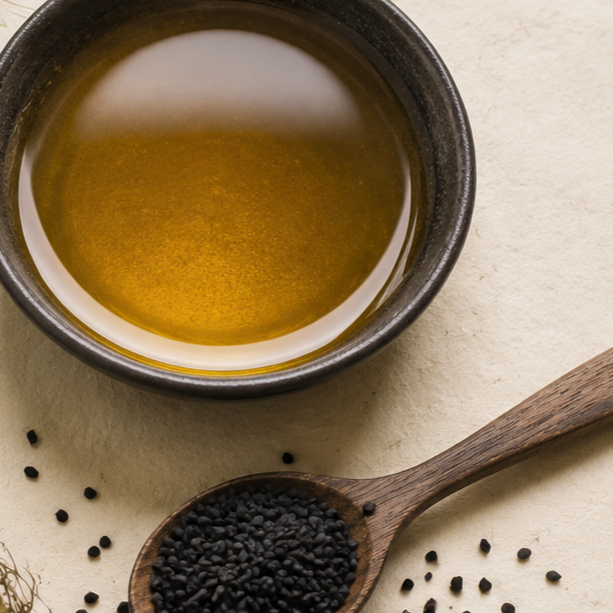
Black seed oil is one of those products that looks deceptively simple.
A bottle says Nigella sativa. The ingredient list says black seed oil. Maybe the front mentions thymoquinone. At first glance, it seems reasonable to assume one bottle should be fairly similar to another.
Research suggests that assumption can be very wrong.
When scientists have actually analyzed commercially available black seed oils, they have found striking differences in their thymoquinone content. Other research shows that seed origin, extraction, refining, storage, and the overall composition of the oil can all influence what ends up in the finished bottle.
That makes black seed oil a perfect example of something we talk about often here:
The ingredient name tells you what is in the bottle. It does not necessarily tell you the quality of what is in the bottle.
First, What Is Thymoquinone?
Thymoquinone, usually shortened to TQ, is one of the best-known bioactive compounds found in Nigella sativa seed oil. It belongs to the volatile fraction of the oil and has received enormous research attention because laboratory, animal, and human studies have explored its antioxidant, inflammatory, metabolic, antimicrobial, and other biological effects.
That does not mean thymoquinone is the only compound that matters in black seed oil.
A 2024 chemical analysis of black cumin oils identified a mixture of volatile compounds including thymoquinone, p-cymene, alpha-thujene, alpha-pinene, beta-pinene, gamma-terpinene, and sabinene. The oils also contained fatty acids, sterols, tocopherols, tocotrienols, and other compounds.
So I would not describe black seed oil as simply “thymoquinone in an oil carrier.”
It is a complex botanical oil.
Thymoquinone happens to be one of its most researched components and one of the easiest markers to use when comparing products.
Two Black Seed Oils Can Contain Very Different Amounts of TQ
This may be the most surprising part.
A 2022 study analyzed six bottled black seed oils and five black-seed-oil capsule products using a validated laboratory method. Researchers found thymoquinone concentrations ranging from only 3.08 mg per 100 grams to 809.4 mg per 100 grams.
That is not a small difference.
It means two bottles both labeled “black seed oil” could provide dramatically different amounts of one of the oil's primary researched compounds.
A separate analysis of commercial black seed oils in Malaysia found TQ concentrations ranging from 0.07% to 1.88% by weight. The highest product contained roughly 27 times as much thymoquinone as the lowest.
This is why I have become much more interested in what a company can tell me about the finished oil, rather than simply seeing Nigella sativa on the label and assuming the rest.
Why Does the Amount Vary So Much?
Black seed is an agricultural product, not a standardized chemical manufactured identically in a laboratory.
Where the seeds were grown matters. Genetics can matter. Climate, soil, harvest conditions, seed storage, extraction, processing, refining, and finished-product storage can all influence the final composition.
A 2024 study compared oils produced from black cumin seeds originating from India, Syria, Egypt, and Poland. The researchers found meaningful variation in several constituents, particularly volatile compounds and tocopherol/tocotrienol content, even though some portions of the fatty-acid and sterol profiles were more consistent. The authors specifically concluded that research on black cumin oil should include chemical analysis of the oil being studied because composition can vary so much.
That conclusion is important.
If scientists cannot assume every black seed oil is chemically interchangeable, consumers probably should not either.
Cold-Pressed Is Helpful Information—but It Is Not the Whole Answer
“Cold-pressed” sounds reassuring, and there are legitimate reasons to care about how an oil is extracted.
Black seed contains volatile and heat-sensitive compounds, and processing can influence the final chemical profile. A 2024 study examining black cumin seed oil during refining found significant losses in several components. Depending on the processing conditions, thymoquinone content dropped by approximately 45% to 97%, while total phenolic compounds and plant pigments also declined.
That certainly gives us a reason to care about aggressive processing.
But I would not turn cold-pressed into another automatic quality guarantee.
A cold-pressed oil can still begin with seeds naturally lower in thymoquinone. It can still be poorly stored. It can oxidize. It can lack testing. And two cold-pressed oils may still contain very different concentrations of TQ.
So “cold-pressed” answers one question.
It does not answer all of them.
Storage Matters Too
Black seed oil does not become chemically frozen in time the moment it enters a bottle.
An experimental study examining freshly extracted and stored Nigella sativa oil found that the fresh oil contained about 33% more thymoquinone than the stored oil used in the experiment.
The researchers also observed changes in biological activity alongside the decrease in TQ.
That does not give us one universal expiration date for every black seed product, because storage conditions, packaging, extraction, oxygen exposure, temperature, and the original oil all vary.
But it does reinforce something very practical:
How an oil is packaged and stored matters.
A beautiful label does not protect an oil from chemistry.
Thymoquinone Percentage Can Be Confusing
This is one place where supplement labels can become surprisingly difficult to interpret.
You may see a bottle describe the total amount of black seed oil in milligrams. Another might state a percentage of thymoquinone. Another may mention a volatile-oil fraction. Another may give a seed equivalent.
Those numbers are not interchangeable.
If a product contains 1,000 mg of black seed oil, that does not mean it contains 1,000 mg of thymoquinone. Likewise, a statement about the percentage of total volatile oil does not automatically tell us the percentage of thymoquinone, because the volatile portion of Nigella sativa contains numerous compounds besides TQ.
This is one reason I prefer straightforward labeling that answers the question directly:
How much thymoquinone is actually present in the finished serving?
If a company gives a percentage, we should also know exactly what that percentage refers to.
Does Higher Thymoquinone Automatically Mean Better?
Not necessarily.
This is where the conversation needs some balance.
Thymoquinone is biologically active. That is precisely why researchers care about it. But if something is biologically active, the goal is not automatically to consume as much as possible.
The 2022 commercial-product analysis did not simply search for the bottle with the most TQ and declare it superior. The researchers were trying to identify a preparation with a known and reasonable thymoquinone exposure that could potentially be used in future clinical research.
There is also no universally established daily thymoquinone target for ordinary wellness use.
Different human studies of Nigella sativa use different oils, seed preparations, extracts, capsules, doses, and treatment durations. That makes it difficult to take one number from one study and turn it into the “ideal TQ dose” for everyone.
What I want is not necessarily the highest possible concentration.
I want a product whose concentration is known, accurately represented, consistently manufactured, and appropriately tested.
What Does the Human Research Actually Show?
There is now a surprisingly large body of human research on Nigella sativa.
A 2025 GRADE-assessed systematic review and dose-response meta-analysis included 82 studies involving more than 5,000 participants. Across studies, Nigella sativa supplementation was associated with changes in several cardiometabolic measurements, including blood pressure, blood glucose, lipids, inflammatory markers, and body-composition measurements.
A separate 2024 meta-analysis of 30 randomized controlled trials found reductions in fasting blood glucose and HbA1c, although heterogeneity between studies was extremely high and results for insulin and insulin resistance were not significant.
A 2026 GRADE-assessed meta-analysis in people with metabolic diseases similarly found modest improvements in several cardiovascular risk markers while emphasizing variability in study quality and outcomes and the need for more well-designed trials.
These are legitimate human findings.
They also demonstrate the problem perfectly.
Those studies have not all used the same preparation. Some used oil. Some used seeds or powders. Some used extracts. Doses and treatment durations varied considerably.
So I would not take a meta-analysis of Nigella sativa supplementation and conclude that every bottle of black seed oil on a store shelf has been clinically proven to produce those results.
The plant has evidence.
The finished product still matters.
Even Clinical Research Has a Standardization Problem
This issue is beginning to receive more attention from researchers themselves.
A 2026 systematic review examining Nigella sativa and thymoquinone preparations in periodontal therapy found encouraging preliminary results across 14 exploratory clinical trials.
But the researchers identified a major problem: only one study adequately reported the daily thymoquinone dose. Without that information, the authors said it was difficult to establish dose-response relationships or reliably reproduce the research.
That review focused on periodontal research rather than general supplementation, but the larger lesson applies beautifully here.
If we do not know what was actually in the oil being studied, comparing results becomes much harder.
Standardization may sound boring compared with phrases like “ancient remedy” and “miracle seed.”
Scientifically, though, it matters a lot.
The Rest of the Oil Still Matters
I also do not want thymoquinone to become so dominant in the conversation that we forget black seed oil is an oil.
Nigella sativa seed oil contains fatty acids, sterols, tocopherols, tocotrienols, and multiple volatile plant compounds. Research suggests some portions of that chemical profile are relatively stable while others vary substantially with seed source and processing.
That means reducing black seed oil quality to a single TQ number may be too simplistic.
Two oils could contain similar thymoquinone concentrations yet differ in oxidation, freshness, fatty-acid quality, other volatile compounds, contaminants, or processing history.
TQ is a useful marker.
It is not the entire oil.
Oxidation Is Another Piece People Rarely Talk About
Like other botanical oils, black seed oil can oxidize.
Researchers measure things such as peroxide value, free fatty acids, and other chemical indicators to evaluate oil quality. The 2024 composition study found considerable variability in these quality indicators among Nigella sativa oils, with elevated acid and peroxide values appearing in some samples.
This matters because an oil can have an impressive botanical origin and still be poorly handled.
Freshness, packaging, oxygen exposure, light, temperature, and storage all influence oils over time. That is one reason I pay attention to dark packaging, storage recommendations, manufacturing information, and whether a company has actual finished-product testing rather than simply discussing the reputation of black seed oil as an ingredient.
What I Look for in a Black Seed Oil
When I compare black seed oils now, I care less about the longest list of promised benefits and more about whether the company can answer some basic quality questions:
Is the botanical species clearly identified as Nigella sativa?
Is the oil extraction method disclosed?
Is the thymoquinone content actually measured or standardized?
If a percentage is listed, is it clear exactly what that percentage represents?
Is there finished-product testing for identity, purity, contaminants, and oxidation?
Is the oil protected appropriately from light and poor storage conditions?
Does the company provide useful quality information instead of relying only on traditional-use claims?
None of those questions guarantees that a product will produce a particular health outcome.
They simply help establish that we have a better idea what is actually in the bottle.
Where the Black Seed Oil I Use Fits
Black seed oil is one of the products I personally keep in my wellness routine, but the reason I find it interesting has changed as I have learned more about it.
At first, it is easy to focus on the giant list of things black seed has been studied for.
Now I care just as much about the product itself.
What is the thymoquinone concentration?
How was the oil processed?
What testing was performed?
What exactly does the label mean when it gives a potency number?
Is that number supported by analysis of the finished oil?
Those questions matter more to me than a company telling me that black seed has been used for thousands of years.
Traditional use can tell us something is worth investigating.
Modern testing helps tell us what we actually bought.
You can find the black seed oil I currently use and recommend on my Products I Recommend page.
What About All the Anti-Inflammatory and Antioxidant Claims?
Thymoquinone and Nigella sativa have been extensively studied for inflammatory and oxidative pathways, and those mechanisms are part of what makes the plant scientifically interesting.
But “has antioxidant activity” is not the same thing as “prevents oxidative damage throughout your body,” and “affects inflammatory pathways” is not the same thing as “treats inflammatory disease.”
The same rule we have used throughout this entire blog applies here:
Mechanism is not the same thing as clinical outcome.
There are human trials and meta-analyses showing potentially useful effects in certain populations. That is much stronger evidence than a cell-culture experiment alone.
But it still does not turn black seed oil into a treatment for every condition involving inflammation or oxidative stress.
Very few health problems are that simple.
Black Seed Oil Can Interact With the Rest of the Picture
Another reason I do not think “more TQ is automatically better” is that Nigella sativa is biologically active enough to affect measurable outcomes in clinical trials.
Research has examined effects on blood glucose and blood pressure, among other measurements. That means someone using glucose-lowering or blood-pressure medications should not assume that taking a highly concentrated black seed product is completely
irrelevant to their treatment plan.
Black seed oil can also cause digestive discomfort or other adverse effects in some people, and safety data for highly concentrated thymoquinone preparations are not equivalent to safety data for traditional culinary use of black seed.
Natural does not mean inactive.
In fact, if we are interested in black seed oil because it contains active compounds, we should respect the fact that those compounds are active.
Where Black Seed Oil Fits in Foundational Wellness
Black seed oil is not something I think everyone needs.
It does not replace food, sleep, movement, hydration, appropriate medical care, or the other foundations that influence health every day.
But it is one of the botanical oils with enough chemistry, traditional history, and human research behind it to deserve serious interest.
The part I think gets lost is that “black seed oil” is not necessarily one standardized thing.
The seed matters.
The extraction matters.
The processing matters.
Storage matters.
Freshness matters.
Thymoquinone matters.
And the rest of the oil matters too.
Once we understand that, choosing a bottle becomes less about finding the most dramatic claims and more about finding the clearest information.
Observe
The next time you see black seed oil, look past the front of the bottle.
If it tells you how many milligrams are in a serving, ask whether that number refers to the oil itself or to thymoquinone. If it gives a percentage, ask what is being standardized. If it mentions volatile oil, remember that the volatile fraction contains more than TQ.
Then look for what is missing.
Does the company provide testing?
Do they explain the extraction method?
Can you tell how the product is stored and protected?
Does the label help you understand the actual oil—or mainly tell you everything the ingredient supposedly does?
There may never be one perfect black seed oil.
But research makes one thing increasingly clear:
Two bottles with the same ingredient name can be very different products.
And knowing that makes us much better consumers.
A Note About Black Seed Oil
This article is for general wellness education and is not medical advice. Nigella sativa and thymoquinone are biologically active and have been studied for effects on blood glucose, blood pressure, lipids, inflammatory markers, and other outcomes. People who take medications—particularly for diabetes or blood pressure—or who are pregnant, breastfeeding, preparing for surgery, or managing a medical condition should discuss concentrated black seed oil supplementation with an appropriately qualified healthcare professional. Do not use black seed oil as a replacement for prescribed treatment.
References
Dąbrowski G, Czaplicki S, Konopka I. Variation in the Composition and Quality of Nigella sativa L. Seed Oils—The Underestimated Impact on Possible Health-Promoting Properties. Molecules. 2024;29(6):1360. PMID: 38542995.
Khaikin E, et al. Screening of Thymoquinone Content in Commercial Nigella sativa Products to Identify a Promising and Safe Study Medication. Nutrients. 2022. PMID: 36079759.
Thymoquinone Content in Marketed Black Seed Oil in Malaysia. Commercial products showed large differences in measured TQ concentration. PMID: 33100788.
Changes in the Quality of Oil Extracted by Hot Pressing From Black Cumin Seeds and by Solvent From the Obtained Cake During Refining. 2024. PMID: 38726404.
Jafari A, et al. Does Nigella sativa Supplementation Improve Cardiovascular Disease Risk Factors? A Comprehensive GRADE-Assessed Systematic Review and Dose-Response Meta-analysis of 82 Randomized Controlled Trials. Pharmacological Research. 2025. PMID: 40714301.
*The Effect of Nigella sativa Supplementation on Glycemic Status in Adults: An Updated Systematic Review and Meta-analysis of Randomized Controlled Trials. 2024. PMID: 39181437.
Musazadeh V, et al. The Effect of Nigella sativa Supplementation on Cardiometabolic Health in Patients With Metabolic Diseases: A GRADE-Assessed Systematic Review and Meta-Analysis. Endocrinology, Diabetes & Metabolism. 2026. PMID: 41858302.
*Preliminary Evidence of Effectiveness of Preparations From Nigella sativa and Its Leading Compound Thymoquinone in Periodontal Therapy. 2026. PMID: 42729546.