If you spend any time in the wellness world, eventually you will hear some version of this advice:
Open your pathways before you detox.
At first, that can sound like the body is a house full of clogged drains that need to be physically opened before anything can get out.
That is not quite how human physiology works.
“Opening the pathways” is not a conventional medical diagnosis, and your liver, kidneys, colon, lymphatic vessels, and bile ducts are not normally sitting around sealed shut waiting for an herbal cleanse to open them.
But underneath the wellness language is an idea that actually makes a lot of practical sense: before adding an aggressive cleanse, make sure the body’s normal systems of digestion, elimination, hydration, circulation, and waste processing are being supported rather than overwhelmed.
That is a very different—and much more useful—way to think about it.
If you are constipated, dehydrated, barely eating, sleeping poorly, and already feeling depleted, piling multiple laxatives, binders, herbs, or “detox” products on top of that may not be the best place to begin.
Sometimes the foundation comes first.
Your Body Is Already Detoxifying Every Day
The word detox gets used so loosely that it can sound like something that only happens when we buy a cleanse.
In reality, your body is constantly processing substances, transforming compounds, filtering blood, moving fluids, and eliminating waste.
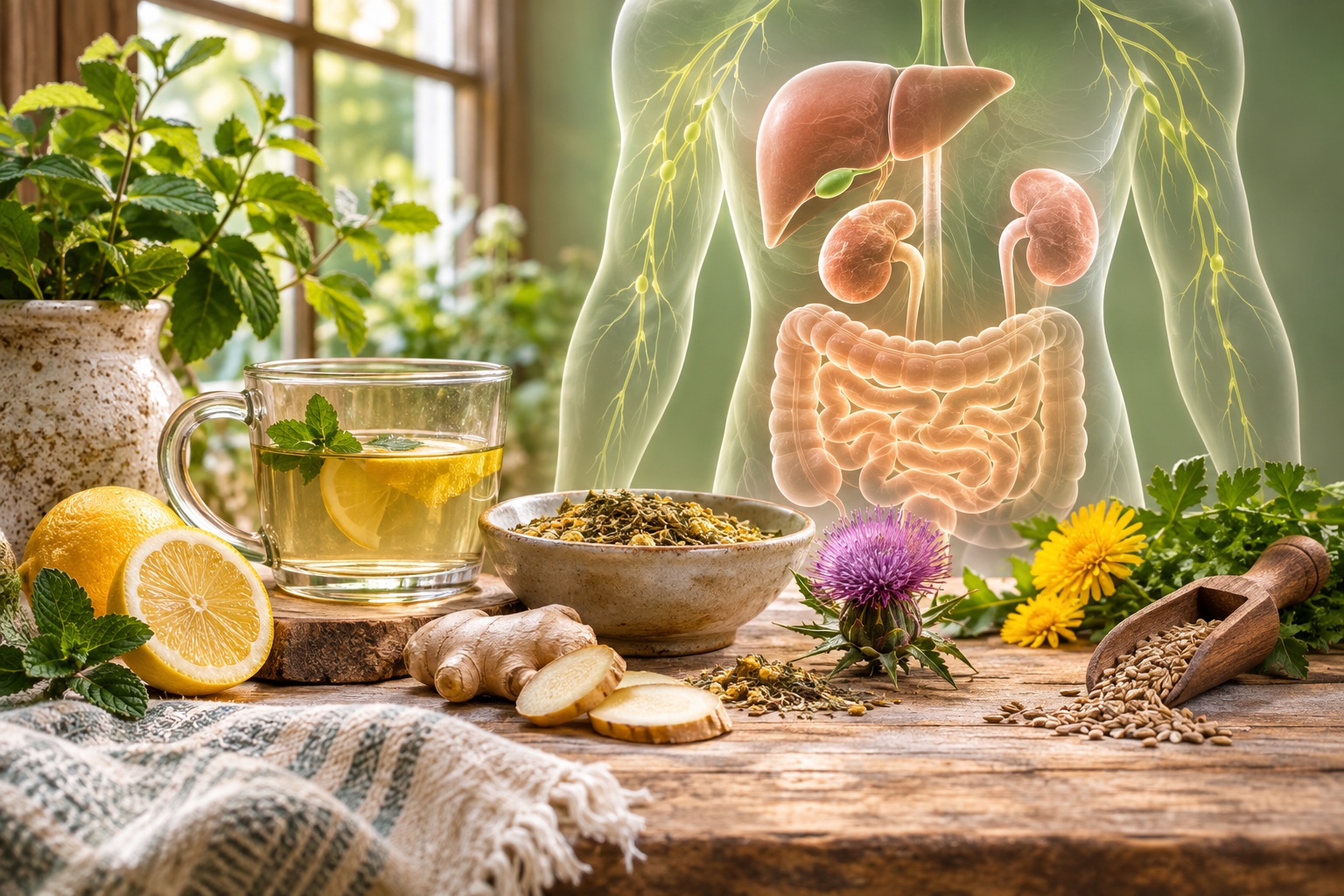
The liver processes nutrients, medications, hormones, alcohol, and many other compounds. It also produces bile, which helps digest fats and provides one route by which certain substances can leave the liver and eventually move into the intestinal tract. The kidneys continuously filter blood, removing wastes and excess water to produce urine. Your digestive tract absorbs nutrients while moving material that will eventually become stool. (NIDDK)
These systems do not work independently. The intestine and liver communicate through portal blood flow, bile acids, lymphatic connections, immune signals, and the gut microbiome. Modern research increasingly refers to this interconnected relationship as the gut-liver axis. (PubMed)
So rather than imagining detoxification as one switch we need to turn on, it makes more sense to picture a network of systems working together all day long.
The Colon: Where Elimination Becomes Very Literal
This is probably the easiest pathway for beginners to understand because we can see the end result.
The large intestine absorbs water and turns the remaining material from digestion into stool. Peristalsis—the coordinated contractions of the intestinal muscles—moves that stool toward the rectum so it can leave the body. (NIDDK)
If bowel movements are very infrequent, uncomfortable, or difficult to pass, it is reasonable to address that before beginning something marketed as a “deep cleanse.”
That does not mean toxins are necessarily poisoning you because you skipped a day of pooping.
It simply means regular bowel function is part of normal elimination, and constipation is already a sign that the digestive system deserves attention.
This is one reason I understand the logic behind beginning a multi-step cleanse with bowel support rather than immediately adding a pile of aggressive herbs.
The Liver and Gallbladder: Processing and Bile Flow
The liver is often called the body’s detox organ, but that phrase oversimplifies an incredibly complex organ.
Among many other jobs, the liver chemically modifies compounds so they can be used, stored, recycled, or eliminated. It also produces bile, which travels through bile ducts and assists with digestion and absorption of dietary fats and fat-soluble vitamins.
If you have a gallbladder, it stores bile between meals and releases it into the small intestine when you eat. If the gallbladder has been removed, the liver still produces bile; it simply flows differently because there is no longer a storage reservoir. (NIDDK)
Bile is also connected to elimination. Some compounds are secreted into bile and eventually leave through the stool, while others are reabsorbed through normal enterohepatic circulation.
This is one reason liver, bile, and bowel function belong in the same conversation rather than being treated as separate wellness trends.
The Kidneys: Your Actual Filtration System
The kidneys may be the least glamorous part of the detox conversation and one of the most important.
Healthy kidneys filter blood continuously, removing wastes, extra water, acids, and helping regulate minerals such as sodium, potassium, calcium, and phosphorus. The wastes and excess fluid then leave the body through urine. (NIDDK)
This is also why hydration matters.
It does not mean drinking enormous amounts of water “flushes toxins” faster. The kidneys regulate water and electrolytes very carefully, and more water is not automatically better.
But becoming dehydrated while simultaneously taking laxatives, diuretic herbs, or multiple cleanse products can create an entirely different problem.
Support does not mean forcing the kidneys to work harder.
It means giving the body reasonable conditions to do the job it already knows how to do.
The Lymphatic System: More Than a “Drainage System”
The lymphatic system is probably the pathway that gets the most creative wellness descriptions.
It is often described as a sewer system full of stagnant toxins that needs to be manually drained.
The real physiology is more interesting.
The lymphatic system helps return excess fluid and proteins from tissues back toward the bloodstream, transports dietary fats from the intestine, and plays a major role in immune surveillance and immune-cell movement. Collecting lymphatic vessels even have their own smooth-muscle contractions and one-way valves that help propel lymph. (PubMed)
Movement, muscle contractions, breathing, body position, and the vessels’ own pumping mechanisms can all influence lymph movement.
So yes, gentle movement and normal circulation matter.
But the lymphatic system is not simply a bucket of toxins waiting to be emptied.
That distinction matters because we can support normal physiology without turning it into something frightening.
So What Does “Opening the Pathways” Mean to Me?
I think of it as a wellness shorthand for preparing the foundation before doing more.
Is bowel elimination reasonably regular? Are you drinking enough fluid for your needs? Are you eating enough protein, fiber, minerals, and whole foods? Are you moving your body? Are you sleeping? Are you starting one thing at a time instead of introducing five aggressive products at once?
Those questions are not nearly as exciting as promising a massive detox reaction.
But they are more useful.
And they also help us interpret something important: feeling terrible during a cleanse is not automatically proof that the cleanse is working.
Headache, diarrhea, cramping, dizziness, nausea, or weakness can sometimes simply mean you are dehydrated, reacting to an ingredient, losing electrolytes, taking too much, or using something that does not agree with you.
The goal should not be to suffer enough to prove that toxins are leaving.
Where the Open Pathways Kit Fits
This is what made the Open Pathways Kit from Restored Identity interesting to me.
The current kit is designed around several of the same systems we have just discussed: bowel regularity, liver and bile support, kidney and urinary support, and nutritional/antioxidant support. Restored Identity specifically positions it as a foundational step before its deeper cleanse programs and includes a seven-day colon phase first. (Restored Identity™)
I would describe that as the company’s wellness framework, rather than saying science has proven everyone must take this kit before detoxing.
What I do like is the order of operations.
Instead of immediately jumping into an intensive parasite, heavy-metal, or other cleanse, the concept starts with the basic systems responsible for digestion and elimination.
Affiliate disclosure: I may earn a commission if you purchase through my link, at no additional cost to you. I share products I believe are worth exploring, but supplements should always be evaluated for your own needs, medications, and health history.
You can find the Open Pathways Kit here.
What Is Actually in the Kit?
This is where supplement pages can get overwhelming, especially when someone is brand new.
So instead of reading a long list of herbs and wondering what any of them are supposed to do, let’s break the kit down by job.
Clean Sweep Colon Support: Helping the Bowel Move
The colon formula contains magnesium glycinate, magnesium oxide, slippery elm, marshmallow root, triphala, and senna. Restored Identity uses this as a seven-day phase at the beginning of the kit. (Restored Identity™)
Magnesium oxide is the ingredient here with the clearest connection to bowel regularity. It can draw water into the intestinal tract and has clinical evidence for improving stool frequency and consistency in constipation. Current gastroenterology guidelines include magnesium oxide as a conditional option for chronic idiopathic constipation. (PubMed)
Senna works differently. It is a stimulant laxative, meaning it stimulates intestinal movement. It also appears in current constipation guidelines, but stimulant laxatives are not something I would casually treat as an everyday “detox” supplement. They can cause cramping and diarrhea, and longer or repeated use deserves more thought than simply assuming natural equals gentle. (PubMed)
Slippery elm and marshmallow root are mucilage-rich herbs traditionally used for digestive comfort. When mixed with moisture, their plant compounds form a slippery, gel-like texture, which is where their soothing reputation comes from. Human clinical evidence is much thinner than the evidence for conventional constipation treatments, so I would think of them as supportive herbs rather than proven colon cleansers.
Triphala is a traditional Ayurvedic blend commonly used for digestive and bowel support. Again, traditional use is not the same thing as proof that it removes toxins, but it helps explain why the ingredient appears in a formula focused on elimination.
For a beginner, the important part is simple: this formula is primarily about bowel movement and digestive comfort, not about scrubbing toxins off the inside of the colon.
Love Your Liver: A Botanical Liver-Support Blend
The Love Your Liver formula combines beet root, milk thistle, burdock root, turmeric, black pepper, dandelion root, red clover, and glycine. (Restored Identity™)
Milk thistle is probably the ingredient most people recognize. Its best-known compounds are collectively called silymarin, and milk thistle has been studied extensively in liver conditions. But the human evidence is mixed, and the National Center for Complementary and Integrative Health notes that clinical trials have not been strong enough to conclude that milk thistle reliably treats liver disease. (NCCIH)
That does not make it useless.
It simply means “supports liver wellness” is much more defensible than saying milk thistle detoxifies or repairs the liver.
Beet root provides plant pigments and betaine, a nutrient involved in methyl-group metabolism. Glycine is an amino acid used throughout the body and is one of the building blocks involved in glutathione production and conjugation pathways.
Turmeric provides curcuminoids that have been extensively researched for inflammatory and antioxidant biology. However, supplement safety still matters. NCCIH notes that highly bioavailable turmeric and curcumin formulations have been linked to liver injury in some people. (NCCIH)
That is especially worth mentioning because this formula also contains black pepper, whose piperine can increase the bioavailability of certain compounds. Piperine can also affect drug-metabolizing enzymes and may alter exposure to some medications at sufficient doses. (PubMed)
Dandelion, burdock, and red clover have long histories of traditional herbal use for digestion, fluid balance, and general “cleansing,” but those traditional uses should not be confused with proof that they remove specific toxins from the body.
For a beginner, I would summarize this bottle as a broad botanical formula built around liver-related nutrients, antioxidants, and traditional digestive/elimination herbs.
Apple a Day: Antioxidant and Glutathione Support
This formula is much easier to understand once we separate the ingredients.
The manufacturer lists apple pectin, N-acetylcysteine (NAC), sodium ascorbate, quercetin, and L-leucine. (Restored Identity™)
Apple pectin is a soluble fiber. Fiber influences stool formation, gut microbes, and the intestinal environment, which is why fiber belongs naturally in a conversation about elimination.
NAC is one of the more scientifically interesting ingredients in the whole kit. NAC provides cysteine, which the body can use to make glutathione, one of its major antioxidant and redox-regulating molecules. A meta-analysis of controlled trials found NAC supplementation increased glutathione and several measures of antioxidant capacity, although effects vary by population and dose. (PubMed)
NAC also has legitimate medical uses, including as an antidote for acetaminophen poisoning. That does not mean taking NAC casually recreates a hospital detox protocol, but it does show that the connection between NAC, glutathione, and liver chemistry is not simply marketing. (FDA)
Sodium ascorbate is a buffered form of vitamin C, while quercetin is a plant flavonoid found naturally in foods such as onions and apples.
For a beginner, I would think of Apple a Day as the fiber + antioxidant + glutathione-support side of the kit.
Kidney Support: Herbs Traditionally Used Around Fluid and Urinary Wellness
The Kidney Support formula contains rosemary leaf, fennel seed, nettle leaf, and olive leaf. Restored Identity describes the blend as supporting kidney and urinary function. (Restored Identity™)
These herbs contain a variety of plant compounds and have histories of traditional use related to digestion, antioxidant support, circulation, or fluid balance. Nettle in particular is commonly included in traditional urinary-support preparations.
But this is an area where I would keep expectations realistic.
The kidneys do not need to be “scrubbed clean.”
They need adequate blood flow, appropriate hydration, healthy blood pressure, functioning kidney tissue, and a reasonable balance of water and electrolytes.
Someone with actual kidney disease, abnormal kidney labs, fluid restrictions, kidney stones, or medications affecting kidney function should not assume an herbal kidney formula is automatically appropriate.
Kidney physiology is too important for guesswork.
Why I Like Breaking the Kit Down This Way
When a beginner sees twenty herbs across several bottles, the whole thing can look mysterious.
Once we strip away the “detox” language, the logic is easier to see.
The colon phase contains ingredients intended to encourage bowel movement and digestive comfort. The liver blend contains botanicals and nutrients commonly associated with liver and digestive support. Apple a Day combines fiber with antioxidant and glutathione-related ingredients. The kidney formula uses herbs traditionally associated with urinary and fluid support.
That makes much more sense than thinking each herb is roaming through the body hunting down toxins.
What I Would Do Before Any Cleanse—Kit or No Kit
This part matters more to me than any supplement.
If I were preparing for a cleanse, I would first make sure I was not starting from a place of depletion.
I would want to be drinking normally, eating adequately, getting protein and fiber, having reasonably regular bowel movements, moving my body, and sleeping as well as real life allows.
I would also avoid introducing a pile of new supplements all on the same day.
If your body reacts, knowing which new ingredient caused the problem is nearly impossible when you started six things together.
Slow is not less effective simply because it is less dramatic.
A “Detox Reaction” Is Not Always a Good Sign
This may be one of the most important beginner lessons.
The wellness world often treats headaches, diarrhea, nausea, fatigue, dizziness, skin changes, or feeling terrible during a cleanse as evidence that toxins are leaving.
Sometimes those symptoms have much simpler explanations.
A stimulant laxative can cause diarrhea.
Diarrhea can cause fluid and electrolyte loss.
An herb can irritate your stomach.
A supplement can interact with medication.
Eating dramatically less can cause headaches and weakness.
None of those things becomes healthier simply because we call it detox.
If a cleanse makes you feel significantly unwell, the answer should not automatically be to push harder.
Where I Think “Opening the Pathways” Is Most Useful
I like the concept best when we use it as a reminder to look downstream before pushing upstream.
Before asking the body to process more compounds, look at the basics of elimination.
Before adding binders, look at bowel regularity.
Before stacking herbs, look at hydration and food.
Before assuming your lymph is “stagnant,” look at how much you move during the day.
Before deciding your liver needs to be forced into detoxification, remember that it has been performing complex chemical processing every minute you have been alive.
The body does not need us to micromanage every pathway.
Sometimes it needs us to stop making its job harder.
Observe
Before beginning your next cleanse, do something very unexciting.
Pay attention.
How often are you having a bowel movement? Is it comfortable? Are you hydrated? Are you eating enough? Are you moving? How is your sleep? Are you already taking medications or multiple supplements that could interact with new herbs?
Then ask what the cleanse is actually supposed to accomplish.
If the answer is simply “remove toxins,” ask which toxins.
If the answer is “open my pathways,” ask which system.
The more specific the question becomes, the easier it is to separate physiology from marketing.
And that is really what foundational wellness is about.
Not doing the most.
Understanding what you are doing before you do more.
References
- National Institute of Diabetes and Digestive and Kidney Diseases. Your Digestive System & How It Works. Describes digestion, bile production, bowel function, nutrient absorption, and stool formation. (NIDDK)
- National Institute of Diabetes and Digestive and Kidney Diseases. Your Kidneys & How They Work. Describes kidney filtration, waste removal, fluid balance, and urine production. (NIDDK)
- Davis MJ, Zawieja SD, King PD. Transport and Immune Functions of the Lymphatic System. Annual Review of Physiology. 2025. PMID: 39441893. (PubMed)
- Chang L, et al. AGA-ACG Clinical Practice Guideline: Pharmacological Management of Chronic Idiopathic Constipation. 2023. Includes magnesium oxide and senna among evaluated constipation treatments. PMID: 37211380. (PubMed)
- NCCIH. Milk Thistle: Usefulness and Safety. Human liver-disease trials remain inconsistent or insufficient for firm conclusions. (NCCIH)
- NCCIH. Turmeric: Usefulness and Safety. Includes current safety information regarding turmeric and highly bioavailable curcumin supplements. (NCCIH)
- N-Acetylcysteine and antioxidant capacity. Systematic review and dose-response meta-analysis of controlled clinical trials; NAC supplementation increased glutathione and several antioxidant-capacity measures. PMID: 36963867. (PubMed)
- Restored Identity. Open Pathways Kit — Liver, Gallbladder, Kidney, Colon & Lymph Cleanse. Used for the current kit formulation, ingredient lists, sequence, and manufacturer-described purpose. (Restored Identity™)