
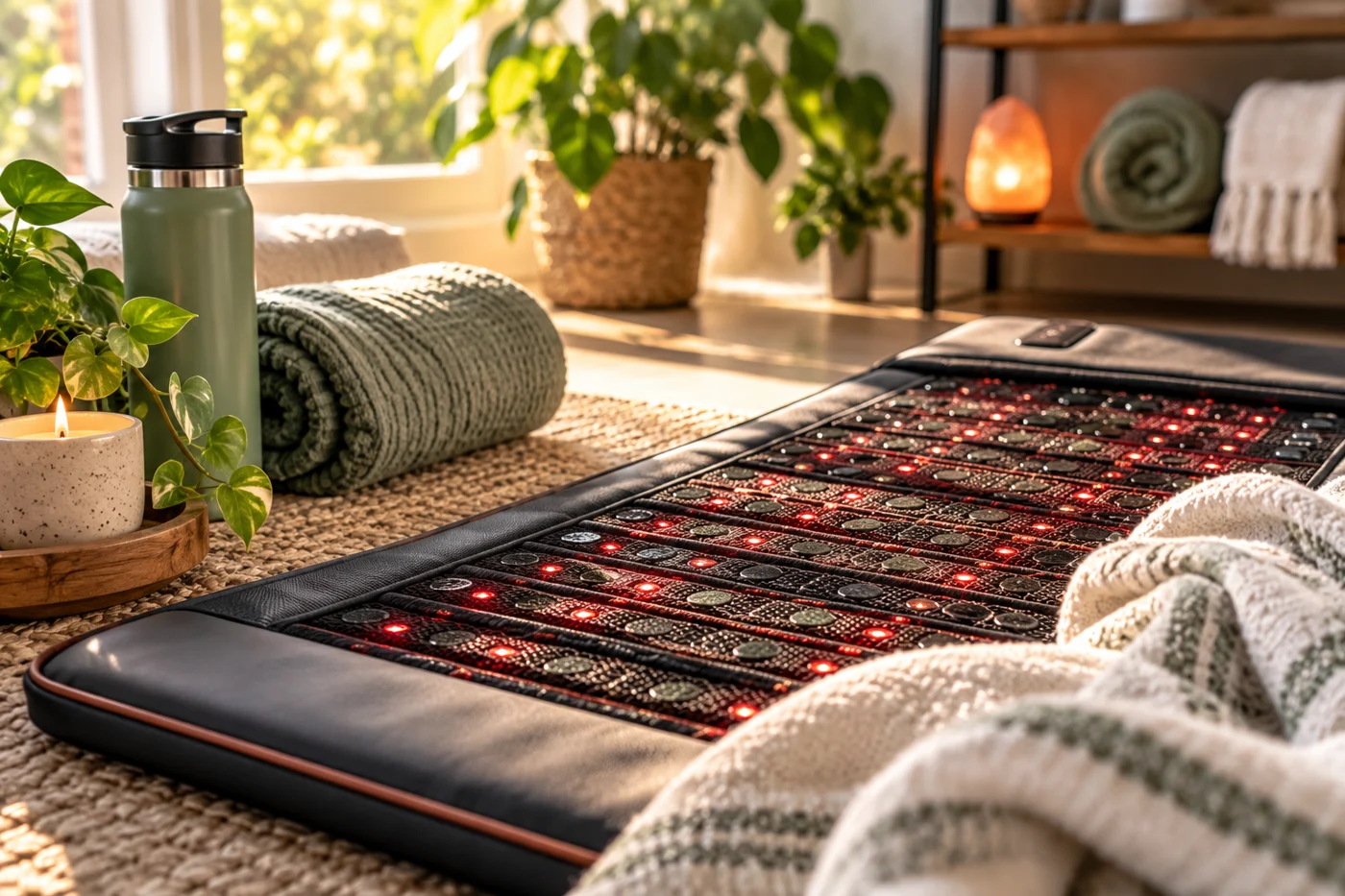
If you have spent any time looking at wellness mats, recovery pads, or newer home wellness technology, you have probably come across the letters PEMF.
It sounds very high-tech, and the marketing around it can make it sound even more impressive.
You may see claims about circulation, inflammation, recovery, energy, sleep, pain, cellular health, and a long list of other benefits. That is usually the point where I want to know what the technology actually is before deciding what to think about all of those claims.
PEMF stands for pulsed electromagnetic field. Unlike a static magnet, which produces a continuous magnetic field, PEMF devices generate electromagnetic fields in pulses.
Researchers have been studying this type of stimulation for decades, particularly in orthopedics and rehabilitation. At the same time, the PEMF device you see built into a home wellness mat is not automatically equivalent to the prescription equipment used in a clinical study.
That distinction is important.
What Is PEMF Therapy?
PEMF devices use electrical current flowing through a coil to create changing magnetic fields.
Those fields can pass through the body without the device needing to physically stimulate the
tissue in the way massage, vibration, or heat would.
Researchers are interested in how these changing fields may influence signaling at the cellular level. Proposed mechanisms include effects on cell-membrane receptors, calcium signaling, adenosine receptors, inflammatory pathways, and the activity of cells involved in bone and connective-tissue repair. The exact biological response depends heavily on the signal being used, including frequency, intensity, waveform, treatment time, and the tissue being studied. PubMed
That last part matters because PEMF is not one single dose or one universal treatment.
Two devices can both say “PEMF” on the box while producing very different electromagnetic signals.
PEMF Is Not Just a Wellness Trend
One reason PEMF caught my attention is that this is not a technology invented recently for expensive wellness mats.
There are legitimate medical applications for electromagnetic stimulation. In the United States, the FDA regulates non-invasive bone-growth stimulators as prescription medical devices. Some of these devices use pulsed electromagnetic fields and are intended to support bone healing in specific circumstances such as established nonunions or certain spinal-fusion situations. FDA Access Data
That is meaningful evidence that electromagnetic stimulation can have biological effects under specific conditions.
It is not, however, proof that every consumer PEMF mat provides the same effects as a prescription bone-growth stimulator.
That is one of the biggest distinctions I think consumers need to understand when researching wellness technology.
What Has PEMF Been Studied For?
Beyond bone healing, PEMF has been investigated for several musculoskeletal applications, particularly osteoarthritis and pain.
A 2024 systematic review looked at 17 randomized controlled trials involving 1,197 people with osteoarthritis. Most of the evidence involved knee osteoarthritis, although several other joints were represented. The authors reported improvements in pain and function across a number of studies, while also noting differences among devices and treatment protocols. PubMed
An earlier review of systematic reviews reached a more cautious conclusion. It found potentially useful effects for osteoarthritis but noted that much of the underlying evidence was of low or moderate quality. PubMed
Those two findings can exist together. There is enough research to make PEMF interesting, particularly in musculoskeletal medicine, while there is still plenty we do not know about the ideal settings, doses, and applications.
Why Frequency and Intensity Matter
This may be the most important part of shopping for PEMF technology.
When we talk about red light therapy, wavelength and irradiance matter. With PEMF, there are also technical parameters that influence what the device is actually delivering.
Frequency describes how often the electromagnetic pulses occur. Intensity describes the strength of the magnetic field. Devices may also use different waveforms, pulse durations, treatment schedules, and coil arrangements.
Researchers have pointed out that the enormous variation among PEMF protocols makes studies difficult to compare. A signal used in one trial cannot necessarily be treated as interchangeable with a completely different signal used elsewhere. PubMed
So when a company says, “PEMF has been clinically studied,” I want to know a little more.
Which PEMF? Which settings? Which outcome? Which population?
Those questions tell us much more than the acronym alone.
More Power Is Not Automatically Better
Wellness products have a habit of turning numbers into competitions.
More LEDs. More intensity. More frequencies. More settings.
But biology is rarely that simple.
PEMF research suggests that cellular responses can vary depending on field strength, frequency, exposure duration, and the type of cell or tissue involved. PubMed
That means I would not choose a PEMF device solely because it advertises the strongest possible magnetic field. I would rather see transparent specifications, understandable instructions, and a company that explains how its settings are intended to be used.
Sometimes appropriate matters more than maximum.
What About Inflammation and Recovery?
You will see inflammation mentioned frequently in PEMF marketing.
There is scientific interest behind that claim. Laboratory, animal, and clinical research has
investigated how electromagnetic stimulation may influence inflammatory signaling, including pathways involving adenosine receptors and cytokine activity. A 2025 review summarized research suggesting PEMF can influence several inflammatory pathways associated with tissue and joint repair. PubMed
But the same distinction we use with supplements applies here too.
Demonstrating changes in an inflammatory pathway is not the same as proving that a home PEMF mat treats inflammatory disease.
That difference matters.
I am comfortable saying researchers are studying PEMF for its effects on inflammatory signaling and recovery. I would be much more cautious about turning that into a sweeping promise about what any particular consumer device will do for an individual person.
Clinical PEMF and Home Wellness Devices Are Not the Same Thing
I think this deserves its own section because it is easy for marketing to blur the line.
Prescription electromagnetic bone-growth stimulators have specific indications, designs, treatment parameters, and regulatory requirements. For example, FDA describes non-invasive bone-growth stimulators as prescription devices intended to promote bone formation as an adjunct to certain fracture or spinal-fusion treatments or for established nonunions. FDA Access Data
A wellness mat containing PEMF is a different product.
That does not mean a home device has no value. It simply means we cannot take evidence from a specific prescription device and automatically apply it to every PEMF product being sold online.
Whenever I look at wellness technology, I want to know what evidence belongs to the technology in general and what evidence actually applies to the device in front of me.
Those are not always the same thing.
What I Look for in a PEMF Device
If I were comparing home PEMF products, I would look past the biggest claims on the front of the website and start with the specifications.
I want a company to tell me what frequencies the device produces, what intensity range it uses, whether different settings actually change those parameters, how long sessions are intended to last, and what safety guidance comes with the device. I also like knowing whether PEMF is the primary technology or one part of a combination product that may also include infrared heat or red light.
That matters because some wellness mats combine several technologies in one device. If someone feels better after using one, it can be difficult to know whether PEMF, heat, red light, simply lying down and resting, or the combination contributed to the experience.
And that is okay.
Not every wellness practice needs to become a laboratory experiment at home.
We just need to be honest about what we know.
Where PEMF Fits in Foundational Wellness
I enjoy learning about technology like this because wellness tools can make supportive practices easier or more enjoyable.
But the technology still needs to stay in its proper place.
A PEMF mat does not replace movement. It does not replace sleep. It does not replace nourishing food, hydration, stress support, or medical care when medical care is needed.
It is a tool.
For some people, lying on a wellness mat for a few minutes may also create something we often forget to schedule: a reason to stop moving, breathe, relax, and give the nervous system a quieter moment.
That part does not require an impressive scientific claim to have value.
The PEMF Tools I Recommend
I have begun including PEMF-capable options in the Wellness Tools section of my Products I
Recommend page because this is a technology I think is worth understanding.
Some of the options I look at combine PEMF with technologies such as infrared heat or red light, so I pay attention to the specifications of each feature rather than treating the entire mat as one mysterious wellness treatment.
My goal with these recommendations is not to convince everyone that they need another device. It is to give people a place to start if they have already decided that this type of technology fits their routine.
Education comes first.
The product comes second.
Observe
If you are considering a PEMF mat or already own one, spend a few minutes looking beyond the product name.
Does the company list its frequencies?
What is the magnetic-field intensity?
Can those settings be changed?
What are the recommended session lengths?
What research does the company reference, and does that research involve a similar device or simply PEMF in general?
Then ask the simplest question of all: What am I actually hoping this tool will support?
Sometimes we buy wellness technology before we even know what role we expect it to play.
Understanding the tool first makes it much easier to decide whether it belongs in your routine at all.
PEMF is a fascinating technology with legitimate medical history and a growing research base.
It also has plenty of areas where evidence is still developing.
We do not have to turn that uncertainty into either hype or dismissal.
We can simply stay curious enough to understand the difference.
A Note About PEMF
This article is for general wellness education and is not medical advice. PEMF devices vary significantly in their design, intensity, frequency, intended use, and safety instructions. Follow the manufacturer's guidance for the specific device you use. People with implanted electronic medical devices, those who are pregnant, or anyone managing a medical condition should discuss use with an appropriate healthcare professional and follow device-specific precautions.
References
Aaron RK, et al. Pulsed Electromagnetic Field Stimulation of Bone Healing and Joint Preservation: Cellular Mechanisms of Skeletal Response. Reviews PEMF mechanisms involving bone, cartilage, adenosine receptors, and extracellular-matrix signaling. PubMed
Paolucci T, et al. Pulsed Electromagnetic Fields (PEMF)—Physiological Response and Its Potential in Trauma Treatment. 2023. Reviews proposed biological mechanisms and highlights the wide variation among PEMF protocols. PubMed
Current Evidence Using Pulsed Electromagnetic Fields in Osteoarthritis: A Systematic Review. 2024. Included 17 randomized studies and 1,197 participants. PubMed
Effects of Pulsed Electromagnetic Field Therapy on Outcomes Associated With Osteoarthritis: A Systematic Review of Systematic Reviews. Reviews the quality and consistency of the osteoarthritis evidence. PubMed
U.S. Food and Drug Administration. Non-invasive bone growth stimulator — Product Classification. Describes prescription electrical, magnetic, and ultrasonic stimulation devices used for specific bone-healing indications.